




What Makes This Recession Different

The 2020 Recession

Unless you’ve been living in a bunker for the last several months, you’ve likely caught the term “recession” thrown around on the news more than once. Hearing this word being used to describe the state of the U.S. economy can trigger a range of reactions from mild anxiety to a full-blown stuffing-money-under-the-mattress panic.

For many people, though, part of their angst surrounding the state of the economy is the vast amount of unknown: What is the exact definition of a recession? How is it different from a depression? How long do recessions usually last? What causes a recession?

So many questions — but we’ve got answers! Here’s all you need to know about recessions, the current state of the U.S. economy and what all of this means to you as a private consumer.

What is a recession? 

A recession is a widespread economic decline in a designated region that lasts for several months or longer. In a recession, the gross domestic product (GDP), or the total value of all goods and services produced in the region, decreases for two consecutive quarters. A healthy economy is continually expanding, so a contracting GDP suggests that problems are brewing within the economy. In most recessions, the GDP growth will slow for several quarters before it turns negative.

What’s the difference between a recession and a depression?

A depression has criteria similar to that of a recession, but is much more severe. For example, in both a recession and a depression the unemployment rate rises; however, during the Great Recession of 2008, the worst recession in U.S. history to date, unemployment peaked at 10%, while during the Great Depression, unemployment levels soared to 25%. Similarly, during the Great Recession, the GDP contracted by 4.2%, while during the Great Depression it shrank by 30%.

Depressions also last a lot longer than recessions. The Great Depression officially lasted for four years but continued to impact the economy for more than a decade. In contrast, recessions generally last only 11 months, according to data from the National Bureau of Economic Research (NBER).

There have been 47 recessions in U.S. history, and a total of 13 recessions since the Great Depression. There has only been a single recorded depression in our country’s history.

What causes a recession? 

A recession can be triggered by a variety of factors:

  • A sudden economic shock that causes severe financial damage.
  • Excessive debt carried by consumers and businesses, leading to debt defaults and bankruptcies.
  • Asset bubbles, or when investors’ make irrational decisions, overbuy stocks and then rush to sell, causing a market crash.
  • Excessive inflation and rising interest rates, which triggers a decline in economic activity.
  • Excessive deflation, which sparks a decrease in wages, further depressing prices.
  • Technological changes, including outsourcing jobs to machines or other technological breakthroughs that alter the way entire industries operate.

Why the COVID-19 recession is unlike any other?

In June 2020, the NBER  announced that the U.S. economy had been in recession since February.

The COVID-19 recession, also known as the coronavirus recession, the Great Shutdown, the Great Lockdown or the Coronavirus Crash, is unique because it was sparked by an unforeseen pandemic and not by any inherent problem within the economy.

Another anomaly of the coronavirus recession is the super-healthy state of the economy before it hit. In February, unemployment levels were at a 50-year low, stock markets were at a record high and the U.S. economy had enjoyed 126 months of growth,  its longest period of uninterrupted expansion in history.

The unusual triggers and the explosive start of the current recession may be good news for its eventual end. Economists initially were hopeful that the recession could reverse itself quickly with a V-shaped recovery. Unfortunately, due to prolonged lockdowns and the nationwide failure to keep infection rates down, they have since declared that a rapid rebound is unlikely. There is still hope for a relatively fast recovery. An April Reuters poll  found that nearly half of 45 economists believed the U.S. recovery would be U-shaped: slower and more gradual than a V-shaped recovery, but still fairly quick.

How will this recession affect me?

The coronavirus recession can impact the average consumer in multiple ways.

First, many are struggling with sudden unemployment or will be facing joblessness in the coming months. The most recent data from the Bureau of Labor Statistics show the unemployment rate at a staggering 10.2%.

Second, the economic uncertainty has triggered record-low interest rates, which in turn sparked a rush to refinance. If you are currently paying high interest rates on a long-term loan, you may want to consider refinancing and enjoying a lower monthly payment.

Finally, investments in stocks, bonds and real estate may lose value during a recession.

The good news is there’s no need to start stuffing money under your mattress. As a member of Freedom FCU, your funds are always safe. [Freedom FCU is federally insured up to $250,000 by the National Credit Union Administration] and independently insured up to [$250,000 by NCUA]. If you are experiencing financial difficulties of any kind, feel free to reach out to us at or to drop us a line at to see how we can help.

Your Turn: What do you think will be most impacted by the coronavirus recession?  Share your thoughts with us on Facebook.
Freedom Federal Credit Union Donates Face Masks and Thermometers to Harford County Public Schools

August 11, 2020Freedom Donates 6000 Face Masks to HCPS

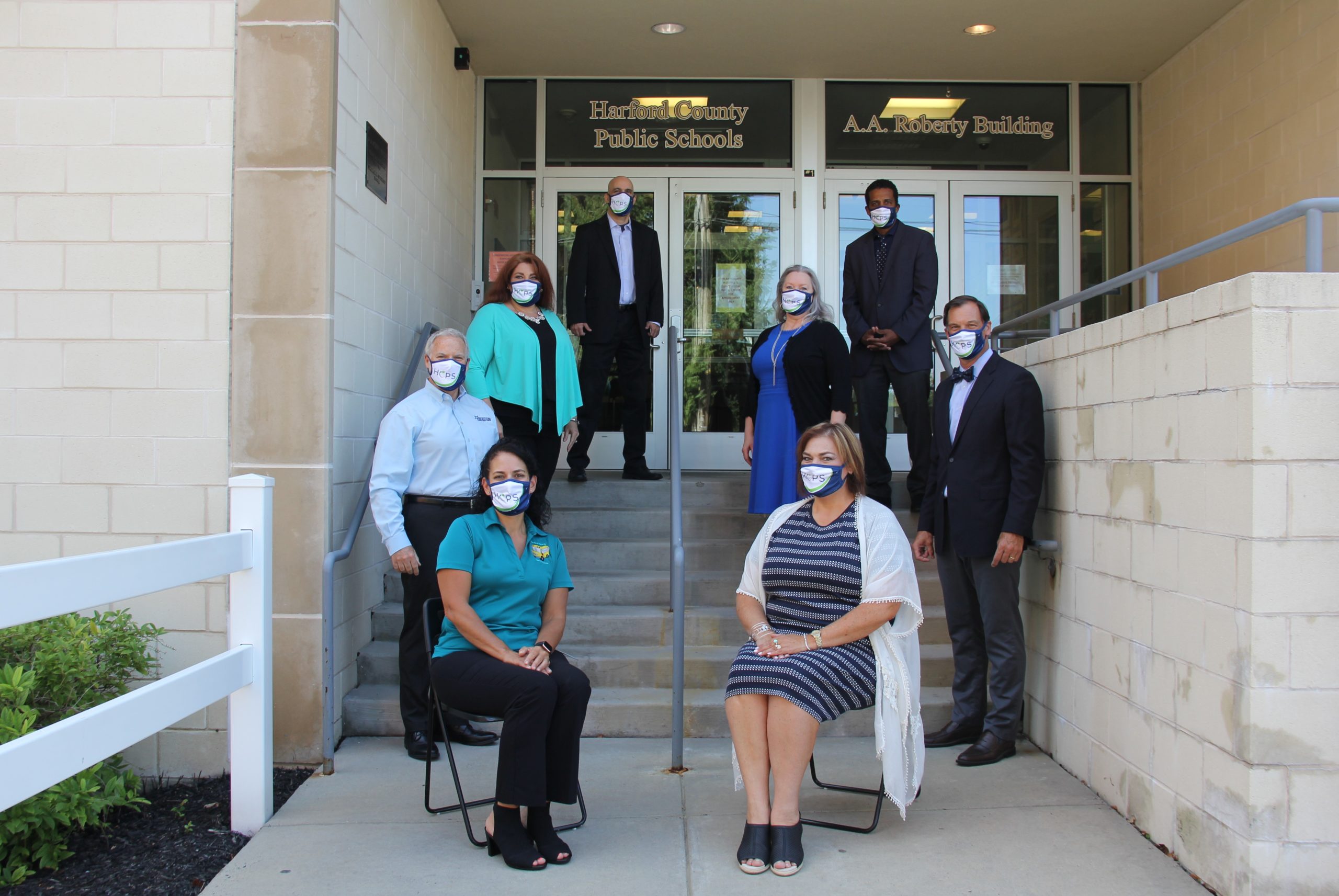
Harford County Public School (HCPS) and Freedom Federal Credit Union leadership and staff representatives gather on the steps of HCPS Headquarters to showcase the new masks that will be distributed to HCPS employees across the school system.
Seated (Left to Right): HCPS Transportation Coordinator Tina Hockaday, representing HCPS support staff, and Halls Cross Roads Elementary School Teacher Laura S. Pohlenz, representing HCPS teachers.
Standing Left from Freedom Federal Credit Union (Front to Back): President and CEO Michael MacPherson, Business Development Director Lisa Snodgrass, and Senior Vice President of Marketing Carmen Mirabile.
Standing Right from Harford County Public Schools (Front to Back): Superintendent Dr. Sean Bulson, Assistant Superintendent for Human Resources Jean Mantegna, and Chief of Administration Eric Davis.

Freedom Federal Credit Union, in partnership with Harford County Public Schools (HCPS), is providing all teachers and support staff with protective, reusable face masks for the upcoming school year. Six thousand masks will be distributed to all teachers, office workers, food service staff, facilities staff, transportation staff, teacher substitutes, and new hires.

Additionally, 30 infrared no-contact thermometers have been donated by Freedom for use in all HCPS school buildings and offices to supplement similar thermometers already available in each school’s health suite. The $26,000 contribution to purchase the masks and thermometers is intended to show appreciation for every HCPS employee’s contribution and dedication, and to provide critical protective equipment to help support HCPS protocols to keep all HCPS employees safe and healthy during the upcoming year.

Freedom Federal Credit Union was originally slated to sponsor the HCPS Annual Employee Service Recognition Program and Awards Dinner, which they have sponsored since 2013. The program recognized hundreds of employees annually who had reached 5, 10, 20, 30, 40, and 50 years of service milestones. Due to the statewide closure of schools, and social function restrictions, the 2020 recognition program was cancelled. Freedom, working closely with school administrators, believed that the face masks would be a great way to show appreciation for all HCPS staff- both in and out of the classroom.

Prior to the decision on whether or not the upcoming school year would resume in person or virtually, both Freedom and HCPS administration recognized that many hundreds of staff members will continue to be required to report in person either regularly or periodically, and that all staff, including those working remotely, would continue to need face coverings for use in any public setting.

“In the best of times, we have always made it a priority to show our teachers that we care about their well-being and appreciate their dedication to the children in our community,” stated President and CEO of Freedom Federal Credit Union, Mike MacPherson. “In what now feels like the worst of times, we know that the pressures our educators, and all those who support our education system, face, will be great, and we hope this sponsorship will show our appreciation for all they do while supporting their health and safety.”

Invited to represent HCPS teachers in a photograph showcasing the new masks, Laura S. Pohlenz, a vocal music teacher at Halls Cross Roads Elementary School, recently completed her 30th year teaching for HCPS. Ms. Pohlenz expressed, “I am happy to represent teachers in this partnership with Freedom Federal Credit Union, and would like to personally thank them for this generous gift of face masks to the school system, in an effort to ensure the safety for our students and staff during this time.”

Representing HCPS support staff in this partnership, Transportation Coordinator, Tina Hockaday, who has been with HCPS for 14 years, remarked, “We are extremely grateful for our partnership with Freedom Federal Credit Union. Thank you for thinking of the safety of our students and staff.”
In the July 29, 2020 Superintendent’s Bulletin, Dr. Sean Bulson, acknowledged the contribution. “This year, FFCU has chosen to recognize all employees of HCPS by donating a protective face mask for every employee. By means of this generous contribution, they would like to honor and show their appreciation for the work done by every HCPS employee as we continue to educate the students of HCPS, while maintaining a safe and protected environment for staff and students. We hope that you will join us in expressing our appreciation to Freedom Federal Credit Union for this generous contribution!”


About Freedom Federal Credit Union

Freedom Federal Credit Union is a community-chartered federal credit union offering consumer financial services to those who live, work, volunteer, worship, attend school, or have family in Harford and Baltimore Counties. Additionally, Freedom offers a full-line of banking services for all businesses, associations, and other organizations that are based in Harford and Baltimore Counties. To learn more, visit freedomfcu.org.

About Harford County Public Schools

The mission of Harford County Public Schools is that each student will attain academic and personal success in a safe and caring environment that honors the diversity of our students and staff.  The vision of the Board of Education of Harford County is to inspire and prepare each student to achieve success in college and career.

Student Loan Changes During COVID-19

Student Loan Relief

With unemployment levels rising and many employers cutting work hours, lots of college grads are now struggling to meet their student loan payments. Thankfully, the federal government has passed legislation to ease this burden. Unfortunately, though, many borrowers are confused about the terms and conditions of these changes.

Here’s all you need to know about the changes to student loan debt during the coronavirus pandemic.

All federal student loan payments are automatically suspended for six months

As part of The Coronavirus Aid, Relief and Economic Security Act (the CARES Act) signed into law on March 27 all federal student loan payments are suspended, interest-free, through Sept. 30, 2020. If borrowers continue making payments, the full amount will be applied to the principal of the loan. The suspension applies to all federal student loans owned by the Department of Education as well as some Federal Family Education Loans (FFEL) and some Perkins loans. Students do not have to take any action or pay any fees for the suspension to take effect.

Additionally, during the suspension period, the CARES Act does not allow student loan servicers to report to the credit bureaus borrower nonpayments as missed payments. Therefore, the suspension should not have a negative effect on borrowers’ credit scores.

If you’re not sure whether your student loan is federally owned, you can look it up on the Federal Student Aid (FSA) website. Be sure to have your FSA ID handy so you can sign in and look up your loans. You can also call your loan servicer directly to clear up any confusion.

Here is the contact information for federal student loan servicers:

Suspended payments count toward Public Service Loan Forgiveness and loan rehabilitation. 

Public Service Loan Forgiveness (PSLF) is a federal program allowing borrowers to have their student loans forgiven, tax-free, with the stipulation that they work in the public sector and make 120 qualifying monthly payments. A disruption of these 120 payments can disqualify a borrower from the program.

According to the CARES Act, suspended payments will be treated as regular payments toward PSLF. This ensures that borrowers who have been working toward these programs will not lose the progress they’ve made toward loan forgiveness.

The same rule applies to individuals participating in student loan rehabilitation, during which borrowers with defaulted student loans must make nine out of 10 consecutive monthly payments to pull their loans out of default. The U.S. Department of Education will consider the six-month suspension on payments as if regular payments were made toward rehabilitation.

Some states and private lenders are offering student loan aid for struggling borrowers.

If your student loan is not federally owned and you are struggling to meet your payments, there may still be options available, such as loan deferment or forbearance. If you are in need of such assistance, contact your lender directly to discuss your options.
Consider an income-driven repayment plan.
If you have an FFEL that is ineligible for suspension, you can lower your monthly payments by enrolling in an income-based repayment plan, which adjusts your monthly student loan payment amount according to your discretionary income. Other lenders offer similar plans, often referred to as income-driven repayment plans. If your salary was cut as a result of COVID-19, or you are currently unemployed, these plans can provide relief by making your monthly payments more manageable.
Employers can contribute toward employees’ student loan debt for temporary tax relief
The federal government offered temporary tax relief for employers contributing up to $5,350 toward their employees’ student loan payments. This benefit is in effect until Jan. 1, 2021 and it can be used for any kind of student debt, whether federal or private.

If you don’t qualify for the student loan payment suspension, you can try speaking with the human resources department at your workplace to find out how they can help you with your student loan debt at this time.
Seeking New Student Loans During the Pandemic
Students and families should start with savings, grants, scholarships, and federal student loans to pay for college. Students and families should evaluate all anticipated monthly loan payments, and how much the student expects to earn in the future, before considering a private student loan.

Freedom is now partnering with Sallie Mae to enable Freedom members access to student loan options that fit their specific educational needs.

Learn More about Freedom’s Student Loan Program.

Your Turn: Have you taken advantage of student loan debt relief offered during the coronavirus pandemic? Tell us about it on Facebook.