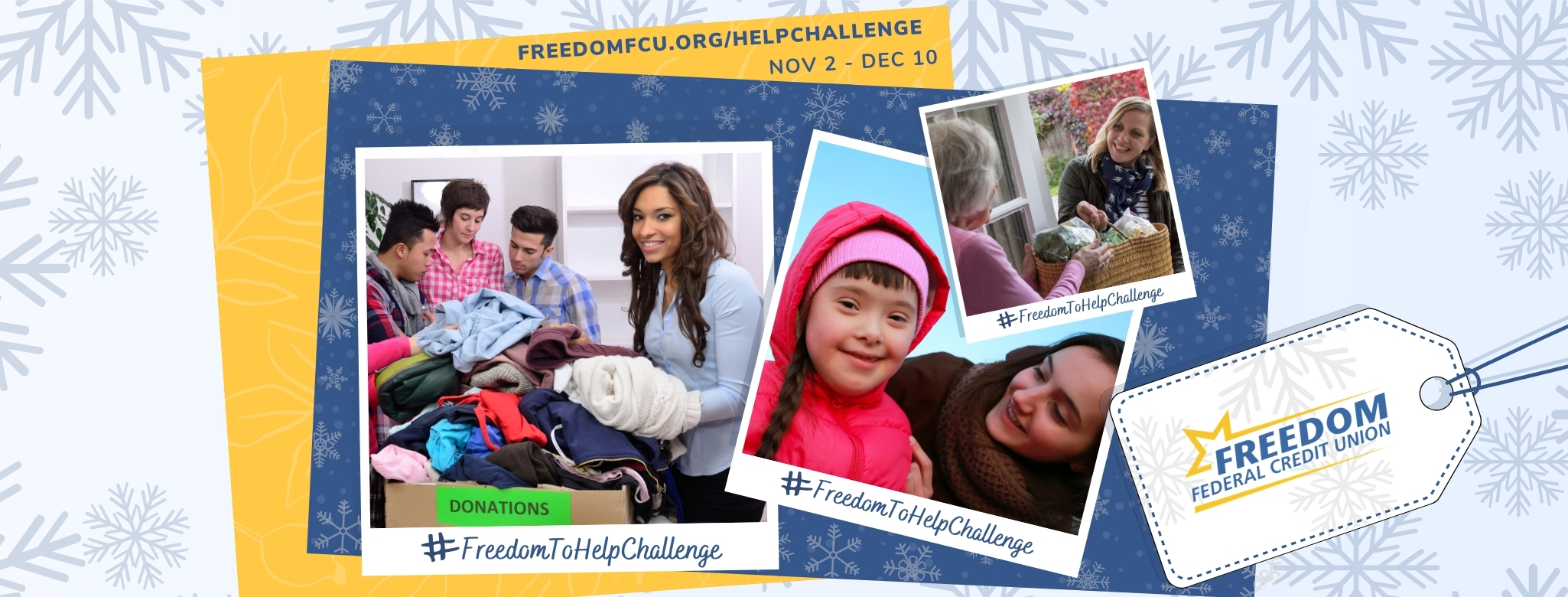



#FreedomToHelpChallenge 2020


#FreedomToHelpChallenge

Win $1,000 for your favorite local charity!

Freedom Federal Credit Union believes in people helping people and we are challenging Harford and Baltimore County volunteers, companies, and non-profits to participate in the award-winning 3rd annual #FreedomToHelpChallenge photo contest this holiday season. Showcase volunteerism in Harford or Baltimore County for the chance to win a $1,000 charitable donation for your local non-profit of choice and other weekly prizes.

HOW TO ENTER:

1. Like or Follow Freedom Federal Credit Union on Social Media (Facebook, Twitter, Instagram)

2. Post public photos showcasing volunteerism in Harford or Baltimore County from November 2nd through December 10th, 2020

3. Include a description of the volunteer effort along with the searchable hashtag, #FreedomToHelpChallenge on every post

4. Visit us on Facebook every Friday to participate in public voting to increase your chances to win! (Every like equals a vote!)

On Instagram? Tag Freedom @FreedomFedCU or DM us to follow you if your account is private.

The #FreedomToHelpChallenge was recognized by CUNA in 2019 with The Dora Maxwell Social Responsibility Community Service Award


Read Full Contest Rules and Details Here.

Grand Prize Info: The Final Showdown

Public Voting for finalists will be available on Freedom’s Facebook page on Tuesday, December 15, 2020 at 10:00 am for 24 hours from the start of the voting period. Every like equals a vote. Share with your friends to increase your votes. The Grand Prize Winner will be announced via Freedom’s Facebook, Twitter, and Instagram page on or before December 16th, 2020.

*Selected charity must be a registered 501(C)3 with a proven focus in Harford or Baltimore County.

2020 Annual Meeting Details

Annual Meeting

Thank You For Registering!

Date: Tuesday, October 13, 2020
Time: 4:00pm

Join us LIVE for Freedom’s 2020 Virtual Annual Meeting, Join LIVE*

*Current Freedom Federal Credit Union membership is required to attend in this meeting.

*** REVIEW THE 2019 ANNUAL REPORT ***

Agenda:

  • 2019 Business Summary / Chairman and CEO Remarks
  • 2020 Business Update
  • Board Elections
  • Committee Reports
  • Approval of Minutes (Annual Meeting Minutes – 04-09-19)
  • New Business / Q&A

MEETING DETAILS:

https://meetings.ringcentral.com/j/1491327680?pwd=YmUxb1pFRm55QVdGdjgxKzcvcjVpUT09 

Meeting ID: 149 132 7680
Password: 017363

— OR CALL IN —

iPhone one-tap :

US: +1(312)2630281,,1491327680#

+1(470)8692200,,1491327680# (US East)

Telephone:

Dial(for higher quality, dial a number based on your current location):

US: +1(312)2630281

US East: +1(470)8692200

Meeting ID: 149 132 7680

Thank you for your membership in Freedom Federal Credit Union!  


*Due to COVID-19 and social distancing restrictions, Freedom’s Annual Meeting, originally scheduled to take place in April 2020, will now be a fully virtual meeting.

Millennials Hit Hardest by Coronavirus Recession

Millennials hit hardest by COVID-19

The coronavirus recession hasn’t been easy on anyone, but millennials may have been hit hardest.

According to many economic experts, the 73 million millennials in the U.S. could experience financial setbacks from COVID-19 that have a longer-reaching impact than those experienced by any other age group.

Here’s why the coronavirus pandemic has been especially hard for those in 25- to 39-year-old age bracket.

Another recession for millennials

Economic recessions are nothing new for this demographic. They already lived through the Great Recession of 2008, and for many, the impact of the last recession is still being felt today.

The Great Recession hit millennials when they were still in college or just starting out on their career paths. For some, it meant the choices for their first post-college job were very slim. For others, it meant dropping out of college when there was no longer a guarantee of a degree netting them a higher-paying job. Regardless of how they were impacted, many millennials are still playing catch-up from the recession of 2008.

“For this cohort, already indebted and a step behind on the career ladder, this second pummeling could keep them from accruing the wealth of older generations,” says Gray Kimbrough, Washington, D.C. economist and American University professor.

Job losses across the board

More than 40 million workers in the U.S. have filed for unemployment since the beginning of the pandemic, but this is another area where millennials have been hit harder than most.

According to a recent report by Data for Progress, 52% of respondents under age 45 have lost jobs, been furloughed or had their work hours cut due to COVID-19. In contrast, just 26% of respondents over age 45 have suffered a job loss of some kind during the coronavirus pandemic.

Millions of millennials have lost jobs that are impossible to do while adhering to social distancing mandates. At the height of the economic lockdowns in April, the economy shed a staggering 20.5 million jobs. Of these jobs, 7.7 million were in the leisure and hospitality sector — a sector that is dominated by millennials. An additional 1.4 million lost jobs were in health care, primarily in ambulatory services — another field that employs a disproportionately large number of millennials.

No nest egg

Many millennials who are still on the rebound from the Great Recession are carrying piles of debt and have minimal savings — or none at all.

According to surveys conducted in 2018 by the Federal Reserve, 1 in 4 millennial families have a negative net worth, or debts that outweigh their assets. One in six millennials would not be able to find the funds to cover a $400 emergency. For these young employees, a relatively mild setback from the coronavirus can be devastating to their finances.

Millennials also tend to neglect their retirements. A recent report by the National Institute on Retirement Security found that 66% of millennials in the workforce have nothing put away for their retirement.

Can millennials recover?

Millennials had still not fully recovered from the Great Recession when the coronavirus pummeled the economy. They have shouldered a large share of job losses and have little or no savings to fall back on.

But there is hope. Millennials may not be as young as they were during the Great Recession, but they still have time to bounce back. They can use the unique challenges presented by the coronavirus pandemic as an opportunity to reevaluate their career track and move onward toward a brighter future.

This age group, also known as Gen Y, is famous for its resilience and can-do attitude. They’ve gotten through the Great Recession of 2008 and they’ll beat the coronavirus recession, too. With hard work, perseverance and small steps toward a better future, millennials can pull themselves up and regain their financial health.

If you’re experiencing financial difficulties, we can help. Call, click or stop by Freedom FCU to speak to a member service representative today.

Your Turn: Are you a millennial who has been impacted by the coronavirus recession? Tell us about it on Facebook, Twitter, or Instagram. @FreedomFedCU